Candidate pressure and party commitments
Netanyahu pressed Ofer Winter and Moti Leitner, chairman of a new ultra-Orthodox party, to withdraw. Rabbi Eli Sadan told Netanyahu and Smotrich that his influence over Winter was limited; Netanyahu argued a public appeal could help undecided voters.
Smotrich’s proposed offer would give Winter a Defense Ministry ministerial position from Religious Zionism’s intended allocation, overseeing proposed administrations for voluntary migration from Gaza and ultra-Orthodox recruitment and military integration. An announcement was promised; no agreement was established.
Winter vowed to continue, condemning the campaign against him and presenting a right-wing leadership alternative willing to acknowledge failure. Smotrich accused Winter’s campaign of attacking him and Netanyahu.
Winter questioned announcing exclusive support for Netanyahu so early but said he would remain in the national camp without a blank check. Yoseph Haddad reiterated support for recommending Netanyahu and advancing their principles in a broad right-wing government.
Leitner said he was not withdrawing and would not discuss concrete steps while Haredi parties refused to commit to reforms Netanyahu promised the community.
Eisenkot and Yisrael Beiteinu leader Avigdor Lieberman urged voters to support one of the four “Serving Bloc” parties, avoid parties that fail to cross the threshold and increase turnout to replace Netanyahu’s government.
Eisenkot pledged:
“I unequivocally pledge that I will not serve under Netanyahu, not even in a rotation arrangement.”
Otzma Yehudit’s sponsored campaign argued a stronger Ben-Gvir would keep a Netanyahu coalition committed to right-wing policies. Bennett pledged to repeal changes to the Judicial Selection Committee, the Police Internal Investigations Department Law, the Attorney General Law and the Communications Law.
The Attorney General barred live broadcasting of Netanyahu’s October 21 graduation speech over election-campaigning concerns. Kiryat Shmona Mayor Avichai Stern backed him a year after Likud tried to unseat Stern municipally.
U.S. Vice President JD Vance said he endorsed candidates only in the U.S. and did not interfere in Israeli elections, despite his election-eve visit supporting Hungary’s Viktor Orbán.
Different polling models, unresolved majorities
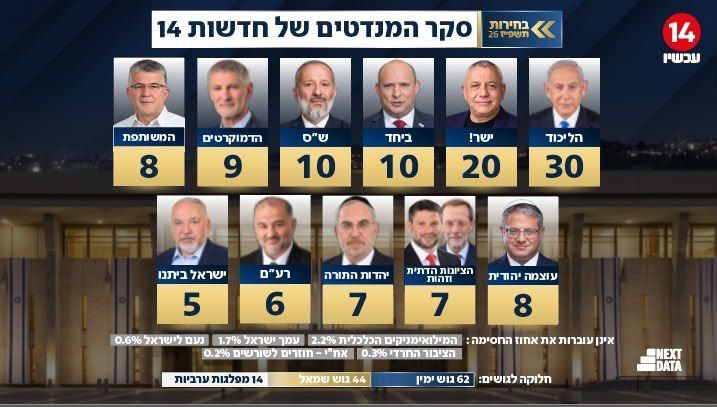
October 20 polls gave Netanyahu’s bloc 58 seats in i24NEWS/Direct Polls, 62 in Channel 14/Next Data and 50 in Channel 16. Likud ranged from 18 to 30 seats and Eisenkot from 20 to 21.
Differences between models exceeded their latest internal movements and did not establish a decisive nationwide shift.
Channel 16’s 50 included Winter’s four; established coalition parties held 46. Its core non-Arab opposition had 52. Adding Hendel–Zelekha’s four and Ra’am’s five produced 61, without evidence of a cooperation agreement.
At the 3.25% threshold, i24NEWS put Winter at 3.1% and Hendel–Zelekha at 2.6%; Channel 14 excluded both, while Channel 16 gave each four seats. Crossing redistributes seats rather than necessarily adding four to a bloc.
The October 20 Channel 14 and Channel 16 figures came through Skarim and were not independently checked against broadcaster originals. i24NEWS surveyed 521 respondents, reporting a maximum sampling error of ±4.3 percentage points.
A later October 21 Channel 14 account again gave Netanyahu’s bloc 62 but reported gains for Deri and Bennett, unlike earlier reported losses for Shas and Bennett. Its comparison baseline was unspecified.
Channel 13’s October 21 evening poll gave Netanyahu’s bloc 49, the opposition 52, Arab parties 15 and Hendel–Zelekha four. Winter was below the threshold; Eisenkot received 20, Netanyahu 19 and Bennett 14.