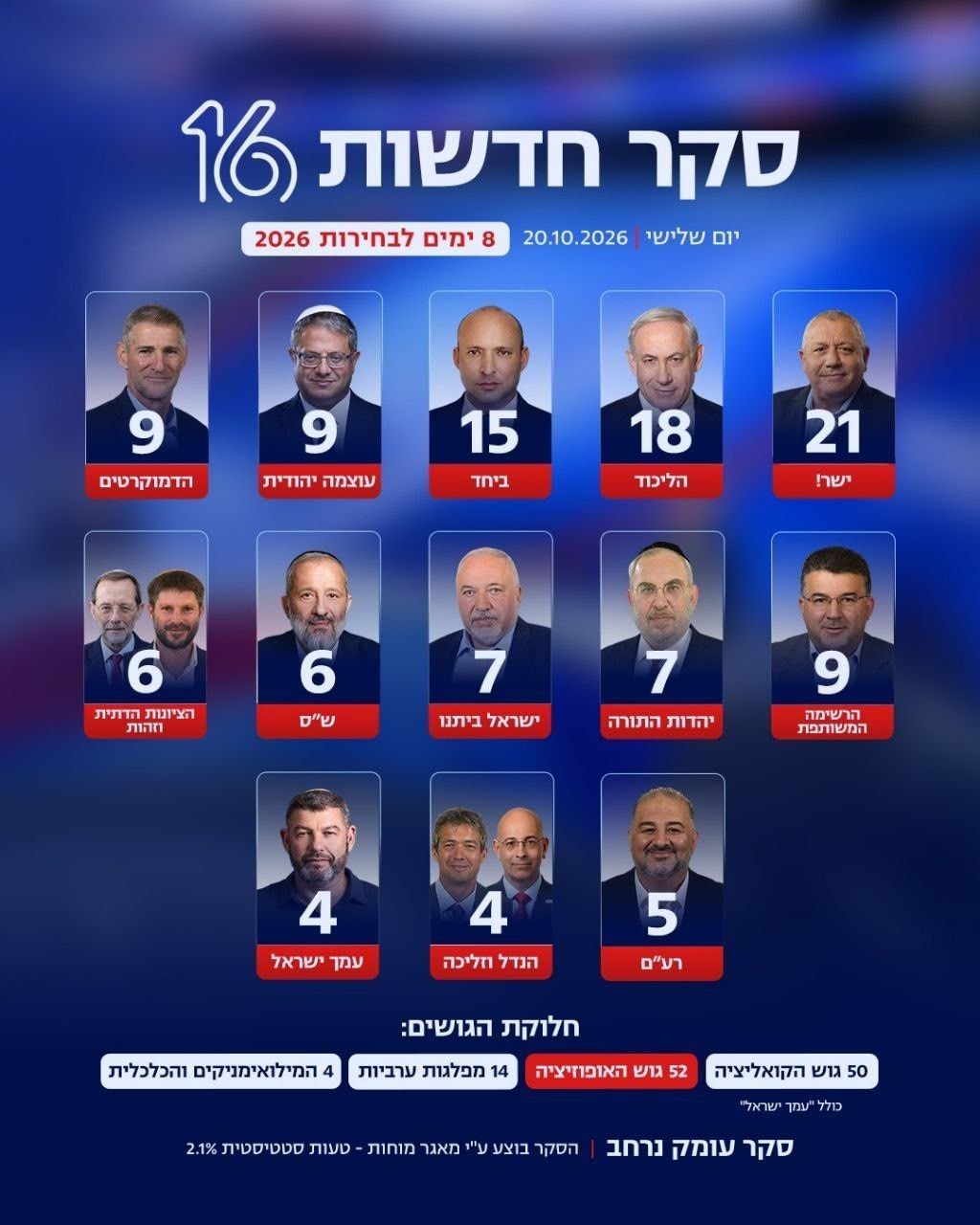
Three polls project sharply different outcomes: Three polls from October 20, seven days before the October 27 election, give Netanyahu’s bloc between 50 and 62 seats. i24NEWS projects 58, three short of a majority; Channel 14 projects 62; and Channel 16 projects 50, with a hypothetical opposition arrangement reaching exactly 61.
The i24NEWS figures come from its original report. The Channel 14 and Channel 16 figures were reported by polling aggregator Skarim and have not been independently confirmed against the broadcasters’ original reports.
i24NEWS puts Netanyahu’s bloc at 58
The i24NEWS/Direct Polls survey shows Netanyahu’s bloc gaining one seat from October 18, excluding Ofer Winter’s party. Likud gains one to 26, while Gadi Eisenkot’s Yashar falls to 20 and Naftali Bennett’s Together to 12. Likud leads Eisenkot by six seats, while its lead over Bennett widens from 12 to 14.
Religious Zionism–Zehut and Yisrael Beiteinu each gain one seat to seven; Otzma Yehudit falls from 10 to nine. The non-Arab opposition holds 48 seats and the Arab parties 14.
The survey included 521 respondents, with a reported maximum sampling error of ±4.3 percentage points.
Channel 14 retains a 62-seat Netanyahu majority
Channel 14/Next Data keeps Netanyahu’s bloc one seat above the minimum majority, with Likud unchanged at 30. Compared with October 19, Eisenkot rises from 19 to 20, while Bennett and the Democrats each fall from 10 to nine.
Otzma Yehudit rises from seven to eight, Shas falls from 10 to nine, and Religious Zionism–Zehut remains at seven. The non-Arab opposition receives 44 seats and the Arab parties 14. Likud’s lead over Bennett widens to 21 seats. Winter and Hendel–Zelekha remain below the electoral threshold.

Channel 16 shows a hypothetical 61-seat opposition arrangement
Compared with October 13, Channel 16 shows Bennett gaining two seats to 15, while Eisenkot holds 21 and Likud 18, leaving a three-seat Likud–Bennett gap. Shas falls from seven to six, United Torah Judaism from eight to seven, and the Joint List rises from eight to nine. Winter retains four seats, while Hendel–Zelekha falls from five to four.
Netanyahu’s bloc declines from 52 to 50, including Winter; his established coalition parties account for 46. The core non-Arab opposition rises from 50 to 52, while the Arab parties hold 14.
Combining the core opposition’s 52 seats with Hendel–Zelekha’s four and Ra’am’s five produces exactly 61, up from 60 previously. This is hypothetical parliamentary arithmetic, not evidence of an agreement to cooperate.

Threshold risks and differences between polling models
The 3.25% electoral threshold remains consequential. i24NEWS places Winter at 3.1%, up from 2.9% and just 0.15 percentage points below the threshold, and Hendel–Zelekha at 2.6%. Channel 14 excludes both, while Channel 16 gives each four seats. Exact percentages for the two lists were unavailable in the Channel 14 and Channel 16 results reported by Skarim.
Crossing the threshold would redistribute seats, rather than necessarily add four directly to an existing bloc projection. Religious Zionism–Zehut appears comparatively more secure at six or seven seats across the surveys. No newly tested Tropper–Hendel merger or other alternative list was identified.
Across these polls, Eisenkot receives 20–21 seats, below his 23–26 in several other recent surveys. Bennett gains in Channel 16 but declines in the other two. Likud ranges from 18 to 30 seats and Netanyahu’s bloc from 50 to 62, differences substantially larger than the latest movements within individual polling series.
The results do not establish a decisive nationwide shift toward either camp, and the governing majority remains unresolved across polling models.